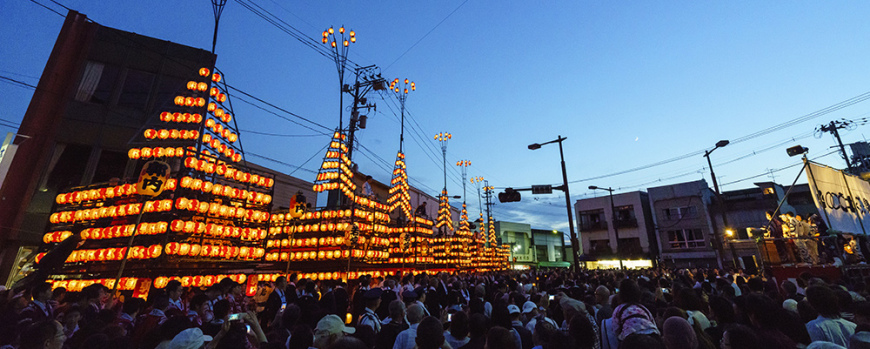
Nihonmatsu Lantern Festival is held from October 4th to 6th every year. The sight of the festival floats, stretching up 11m at their tallest, shining bright in the evening light makes Nihonmatsu famous as the home to one of the top three lantern festivals in Japan.
Pick from countless delicious festival food stalls, try and find the best place to snap photos of awe-inspiring festival floats, kanpai with the locals and see if you can master the festival chants, at this fun, high-energy festival.
What is the story behind this festival?
The festival was started around 370 years ago by the lord of Nihonmatsu Castle. When he first took charge of the Nihonmatsu area, he wanted to ensure the loyalty of the local people by first installing them with lots of religious piety. To do this, he decided to start a shinto festival which could be attended by anyone, regardless of status.
What happens during the festival?
The festival takes place over 3 days every year; October 4, 5, and 6. On October 4, priests give blessings at the local shrine, and 7 floats representing 7 areas of town are lit with hundreds of beautiful, red lanterns.
As the sun sets, the festival atmosphere begins to intensify, and a number of processions with long histories take place.
As with lots of festivals in Japan, the locals who take part in moving the floats shout out encouraging chants to each other and play music. At the Nihonmatsu Lantern Festival, each float has its own music and own drum beat.
The evening of October 4 is the highlight of the festival. This is when all 7 of the floats take part in a procession around the streets of Nihonmatsu City. Seeing these 7 huge floats making their way through the crowded, excited streets of Nihonmatsu is really a special experience.
It is made even more breathtaking by the fact that during these processions, the floats appear to challenge each other through acts such as running at great speed and spinning around wildly. It’s sort of like a dance-off.
Fascinating Floats
Each festival float has 300 paper lanterns attached to it, each made in Nihonmatsu, and each with a real candle inside it. These candles are replaced when they burn down the length of a cigarette, and must be replaced quickly to avoid setting fire to the lanterns. In just one night, it’s estimated that each float uses up 1500 candles!
In addition to the 300 lanterns used in the main body of the float, one thing that really sets apart the floats in this Nihonmatsu Lantern Festival are the suginari decorative lanterns right at the top of the float.
There are also two large lanterns held by local people at the front and back of the float. These two large lanterns signify the border of their area of Nihonmatsu. During festival time, it is not really permitted for people from other areas to enter in this space.
Festival Float Procession
There are many jobs involved in being part of a festival float team.
One of the most important jobs in the festival is that of the local people who push the floats during the 3 days of the festival. They make quite a show of this job, and appear to be competing with floats from other areas when they run up and down the streets, some even swinging their floats round dramatically.
Another important job is steering the float by shouting directions. This important role is played out whilst walking backwards, and shouting out to the rest of the team members.
The steerer works together with another team member who looks out for telephone lines and other objects which the suginari decoration could get caught up in. This person also replaces the candles in the large lanterns at the front and back of the float.
Orchestra members also ride inside the floats. Usually 4 people play large and small Japanese taiko drums, 5 people play windpipes, and others play hand-bells inside just one floats. Other important members of the float team are the guys in the photo below, who keep the crowd, and the rest of their float, pumped for the whole of the festival with their chanting!
I attended the Nihonmatsu Lantern Festival last year and would definitely recommend it. Not only is the atmosphere fantastic, and the floats amazing, but it is also really easy to get to on public transport! The festival area begins right outside Nihonmatsu train station. Make sure you pick up a map telling you where the floats will be a certain times during the evening at one of the information stands. Here is a link to this year’s map (in Japanese).
Cost
The festival is free to join!
Date & Time
- October 4: 17:30 – 23:30
- October 5: 8:30 – 15:00
- October 6: 17:30 – 20:30
Getting there
By public transport:
- From Tokyo, take the Shinkansen from Tokyo to Koriyama, then change to the Tohoku Honsen Line in the direction of Fukushima. Get off at Nihonmatsu Station. This takes around 90 minutes.
- From Sendai, take Shinkansen from Sendai to Fukushima, then change to the Tohoku Honsen. Take the Tohoku Honsen Line in the direction of Koriyama Staiton and get off at Nihonmatsu Station. This takes 50 minutes. There is also a highway bus from Sendai which takes around 70 minutes to reach Nihonmatsu Station.
By car:
Take the Tohoku Highway, get off at Nihomatsu IC. From there, the station is only 2km.
Other posts about Nihonmatsu
What did you think about this post?
If you liked it, please leave a comment and sign up for email updates here!


Great photos! Would be nice to be there someday.
LikeLiked by 1 person
[…] Are you convinced that you should try yet? No? Well, then here’s a wonderful excerpt from Zoe Miriam, friend to many and our resident Fukushima Expert over on Rediscover Fukushima: […]
LikeLike