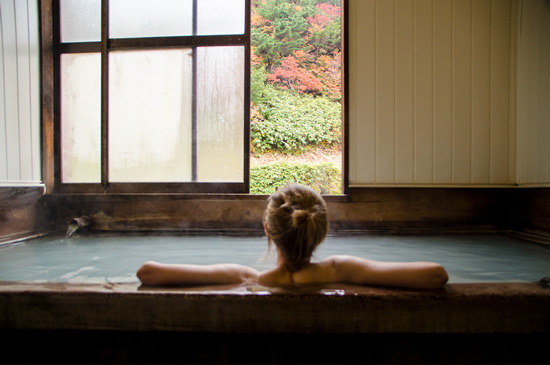
What is an Onsen?
The word ‘onsen’ is often used to mean a naturally occurring hot spring source, but can also refer to baths filled with onsen water. The word ‘onsen’ also features in the names of hot spring resort towns and villages. For example, ‘Higashiyama Onsen’ refers both to the hot spring source in the area, and is also the name of the town. This can be a little confusing when you first come to Japan!
Japan is said to have around 2500 hot spring resorts, and approximately 130 of these are in Fukushima Prefecture! Usually onsen that people visit in Japan will be around 38-42°C but they can get much, much hotter! Onsen resorts have been popular places to stay when travelling far from home for centuries, and are loved by both Japanese guests and those from abroad.
Relaxing, having some ‘me time’, socialising with friends and family, for health purposes - there are many reasons that people go to onsen!
Some people are put off from bathing in onsen because of feeling nervous about being naked in front of stranger or – even worse – someone you know. I’m very used to onsen culture now, but I understand this fear.
That being said, being naked in front of strangers at onsen is something so natural for Japanese people that you really don’t need to worry about being stared at.
If you’re not convinced, I explained in my blog post last week about the blessing that is Kashikiriburo (reserved private baths) so please have a look at that if you’re interested.
In this post I’d like to provide information about a variety of ways to experience onsen.
First of all, let’s consider places where visitors can enjoy onsen, which can be split into 3 categories:
Places to Try Out Onsen
| 1 | Public foot-baths | Open every day in public spaces. Anybody can use these foot-baths to warm their feet for free. |
| 2 | Public Baths | Public baths are buildings containing baths supplied with onsen hot spring water. Public baths are separated by gender. There is usually a small cost to go to the public bath, and a separate cost if you’d like to buy a small body towel. Public baths tend to cost between 200 yen to 500 yen |
| 3 | Accommodation facilities | Hotels, ryokan and other accommodation facilities often include onsen-sourced baths that their guests can enjoy. |
This 3rd category tends to be split into ryokan/hotels that offer daytime access to customers, even those who don’t stay the night, and those that only let their overnight guests use their onsen. Depending on the size of the facility, a day visit to a ryokan’s onsen can cost between 700 yen and 2000 yen. On the other hand, it usually doesn’t cost any money for overnight guests to bathe in shared baths with other guests.
The way to use these onsen depends on which of the above categories that onsen facility that you’re visiting belongs to. See below for more info!
How to Use Onsen
| 1 | Public foot-baths |
|
| 2 | Public baths |
|
| 3 | Accommodation Facilities | If you’re visiting during the day, and are not staying the night:
If you stay in the ryokan or hotel:
|
When you go to an onsen for the first time, you might see lots of different onsen-related words and hear new terms, especially if you’re at a ryokan. Here’s a list of common terms and their meanings.
Basic Terms
| お風呂 | Ofuro | Bath |
| 共同浴場 | Kyodo Yokujo | Public Bath |
| 混浴風呂 | Konyokuburo | Mixed-gender bath |
| 貸切風呂 | Kashikiriburo | Reserved Private Bath |
| 温泉源 | Onsen-gen | Onsen source |
Note: Unless it specifically says “Konyokuburo”, it’s pretty safe to assume that the ryokan hotel’s onsen will be gender separated. By the way, the kanji for woman is 女 and the kanji for man is 男, so follow these signs and find the right bath!
Types of Bath
From Sodium bicarbonate springs and sulphate springs to tea baths and wine baths, there are many types of onsen baths, and lots of people use them for the healing properties of their water.
Many onsen baths have medicinal qualities thought to help with a range of health issues including bad blood circulation, eczema and muscle soreness. Onsen water often comes in lots of consistencies and colours, depending on what minerals or properties they contain!
Here are some words that might come in handy at the onsen:
| 掛け湯 | Kakeyu | Onsen water to splash over your body before you get in the bath |
| ぬる湯 | Nuruyu | Warm water |
| 内風呂 | Uchiburo | Inside bath |
| 外風呂 | Sotoburo | Outside bath |
| 露天風呂 | Rotenburo | Open-air bath |
| 客室露天風呂 | Kyakushitsu Rotenburo | Open-air bath attached to guest room |
| 岩風呂 | Iwaburo | Stone bath |
Onsen manners
Onsen manners are pretty easy for foot-baths (don’t touch anyone else’s feet with your feet and don’t eat / drink while using the foot-bath.)
But figuring out the manners for public baths and ryokan / hotels etc can be a little difficult. Here’s a simple list of some dos and don’ts for onsen visits:
Dos and Don’ts
Dos
- Do place all your valuables in a locker if provided (or leave them in your room if you’re staying the night)
- Do take off all your clothes before moving from the changing rooms to the wash room
- Do cover your tattoos with plasters or something similar (or make use of private reserved baths).
- Do feel free to try out the different selections of shampoo, conditioner etc on offer at ryokan / hotels
- Do wash off all the soap from your body before entering the bath.
- Do splash yourself with kakeyu water from the onsen with the provided buckets before stepping in.
- Do sit out of the bath for a little while if you feel quite hot.
- Do get out of the bath if you feel extremely hot, if your face is red and/or you feel palpitations (this means you’ve been in the bath too long).
- Do rinse yourself after bathing in an onsen if the water is acidic and/or you have sensitive skin.
- Do dry yourself off lightly with a towel before walking back into the changing rooms.
Don’ts
- Don’t get in the bath if you’re drunk or dehydrated!
- Don’t feel embarrassed! Onsen is part of Japanese culture and no one is going to be judging your body
- Don’t stand up while showering
- Don’t get your hair in the onsen water
- Don’t be shy – say hello to the people you’re bathing with in the bath!
- Don’t stay in the bath too long!
- Don’t go in the onsen baths more than 3 times in 1 day.
- Don’t get out of the bath too quickly when you get out. Getting out slowly will help your body acclimatise to the temperature change.
- Don’t worry too much about rinsing yourself after bathing if your skin doesn’t tend to be sensitive. Many types of onsen water include minerals that are good for your skin, so lots of people prefer showering later in the day.
- Don’t forget to drink lots of water after re-entering the changing rooms!
- Don’t forget to hand your towels back before you leave!
Remember to check with your doctor before going to onsen if you have a medical condition (especially one related to cardiovascular problems) and/or if you are pregnant, just to be safe.
As soon as I started writing this, I realised there is a lot more to writing about regarding onsen then I previously thought!
I hope this blog post has been helpful. Let me know if there’s anything I forgot.
What did you think about this post?
If you liked it, please leave a comment and sign up for email updates here!


What are the health benefits of Onsen bath? other than relaxation and novelty.
Is it therapeutic for arthritis?
LikeLike
There are thought to be a number of health benefits. For example:
- Pain relief from muscle pain & arthritis
- Improved blood circulation
- Relaxation & getting good quality sleep afterwards
- Relieves symptoms / can help improve certain skin conditions like eczema
LikeLike
Very thorough and informative! I personally tend to pull the “use public baths when others are least likely to be in there” move, so my exposure to bathing with strangers (ha, ha) has been minimal. That said, though, the water is so soothing and it really is an experience worth having.
LikeLike
That’s a good point! What time slots do you recommend for bathing for people who don’t want to share their bath with strangers?!?!
LikeLike